Internal links vs external links: PageRank math and GEO strategy
Internal links connect pages within the same domain via href attributes pointing to self-hosted URLs. External links point the href to another domain entirely. At the HTML level, both are identical anchor tags. The difference lies in what happens when search engines and AI systems process them. Internal links recalculate and redistribute PageRank across self-hosted pages, letting you control and concentrate ranking equity. External links transfer equity away from your domain but establish E-E-A-T signals and credibility in return. In PageRank distribution, internal links keep authority circulating within your owned asset; external links are departures that cost equity but gain citation credibility. For Generative Engine Optimization (GEO), internal links help large language models map entity relationships and understand your site's knowledge graph structure. External links signal authority to both traditional crawlers and AI systems consuming your content for training or retrieval.
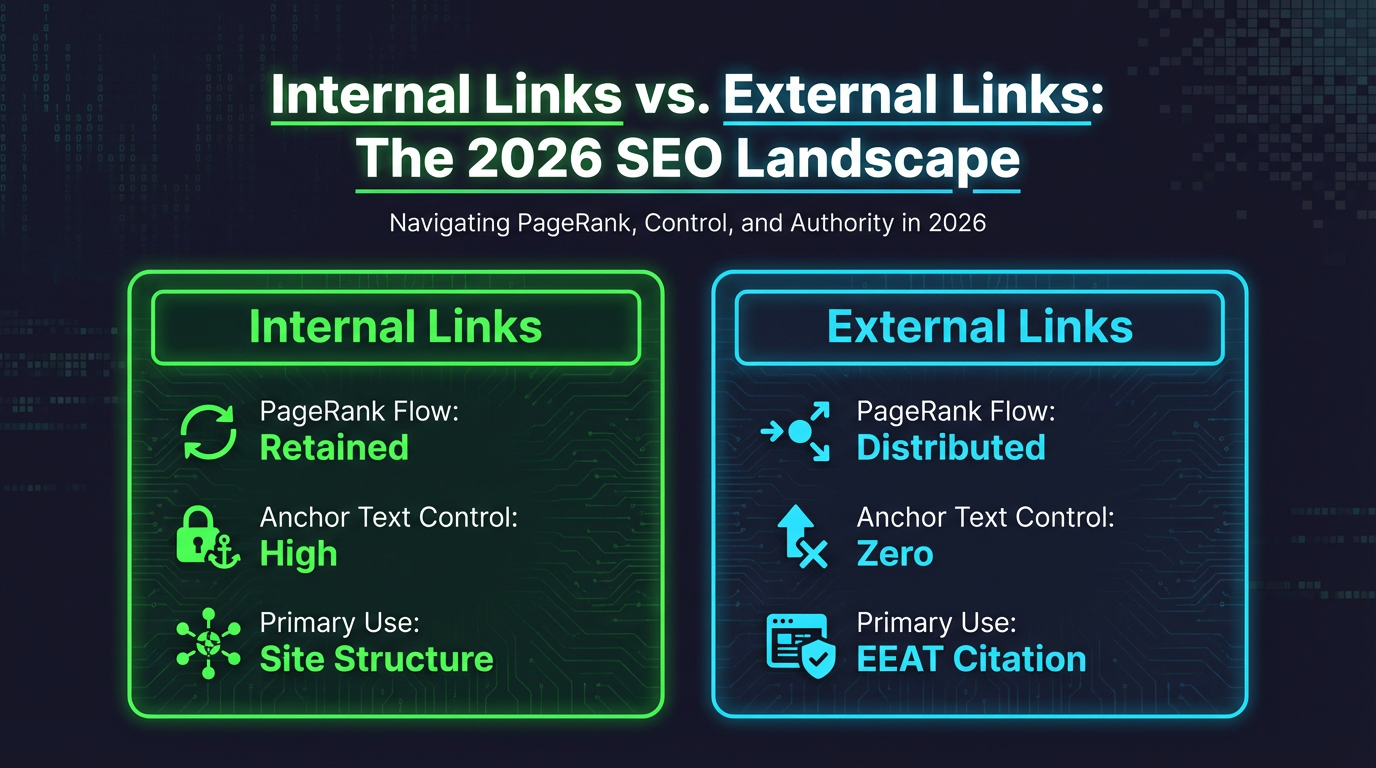
Comparison table: internal vs external link attributes
| Attribute | Internal links | External links |
|---|---|---|
| Domain destination | Same domain | Different domain |
| PageRank impact | Redistributes equity within domain | Transfers equity away from domain |
| Anchor text control | Full control; keyword-rich anchors expected | Limited control; over-optimization causes penalties |
| Crawl depth effect | Affects how deep crawlers reach pages | Does not affect crawl depth |
| E-E-A-T signal | Weak direct signal | Strong signal for authority and expertise |
| GEO impact (LLM parsing) | Maps entity relationships within site | Verifies claims and sources for AI training |
| Link velocity sensitivity | Lower penalty for rapid linking | Higher penalty for unnatural linking patterns |
| Click-through tracking | Your analytics capture it | Third-party tracking (if monitored) |
What is the difference between internal and external links?
The mechanical difference is absolute. When Googlebot crawls an href pointing to example.com/page-b from example.com/page-a, it treats that as an internal PageRank flow. When it encounters an href pointing to external-site.com/resource, PageRank stops at the domain boundary. Your site loses that equity.
Most SEO practitioners say internal links are better because they keep equity on your domain. That is correct but incomplete. External links serve a different purpose: they reduce your domain's entropy by pointing to authoritative sources as verification. A page that cites a peer-reviewed study or a Google Search Central document is making a different kind of claim about its own reliability than a page that cites nothing.
For readers, the practical difference is also clear. Internal links keep users navigating your site. External links send them elsewhere. Both behaviors matter, but they serve different goals in the same strategy.
PageRank math: equity retention vs external validation
PageRank distribution follows a mathematical model where equity flows through links and diminishes with each hop. Moz's internal linking research and Ahrefs' link equity mapping both confirm that a link from your homepage to a page two levels deep transfers more equity than a link to a page three levels deep. This is the crawl depth effect. Internal linking lets you control this flow directly.
If your homepage links to Page A, and Page A links to Page B, Page B receives less PageRank than it would if the homepage linked to it directly. Every additional hop in the chain reduces the equity that arrives at the destination. This is why keeping high-priority pages close to the homepage in link distance matters: not as a rule of thumb, but as a mathematical consequence of how PageRank propagates.
External links do not advance your PageRank but they serve E-E-A-T verification. When you cite a study from a .edu domain or link to authoritative content from a source like Mayo Clinic, search engines treat that as factual corroboration. LLMs parsing your site for training datasets use external citations as ground-truth verification signals. A page with several external citations to authority domains is treated differently than a page with none, even if both have identical internal linking structures.
The equity math also depends on link count. Internal link equity is divided per page based on the number of outbound links on the source page. If your homepage has 50 outbound internal links, each receives a fraction of the homepage's available equity. Reduce that to 10 links and each receives a proportionally larger share. External links do not participate in this calculation. They are a separate signal class entirely.
Anchor text distribution based on the 2026 LinkStorm study
The 2026 LinkStorm study analyzed 2.5 million contextual links across 1,700 websites and found that anchor text distribution differs dramatically between internal and external links. For internal anchors, 81% were keyword-rich, matching the target page's primary topic directly. Only 15% of internal anchors used generic terms like "read more", "click here", or "learn more".
External anchors showed a different pattern. The proportion of exact-match keyword anchors was substantially lower, which reflects search engine penalty thresholds. Google's link spam algorithm is sensitive to external anchor text patterns: high exact-match density across inbound links signals an artificial link-building campaign. Internal anchors have a much higher tolerance because that is the site owner's editorial choice; search engines expect you to use descriptive, keyword-rich text when linking within your own site.
The practical implication is that internal anchor text strategy and external anchor text strategy require different thinking. For internal links, using descriptive, keyword-aligned anchors is both expected and beneficial. For external links pointing to your domain, semantic variation across anchor text from different referring domains is not cosmetic; it directly affects how your link profile looks to Google's spam detection systems.
Beyond a certain number of unique anchor variations pointing to the same internal page, adding more variety shows no measurable ranking improvement. The gains concentrate in the early variations. For external anchors, the concern is the opposite: a referring domain that uses the same exact-match phrase repeatedly across multiple links reads as unnatural to algorithmic review.
Generative engine optimization (GEO) and link structure
Generative Engine Optimization (GEO) is the practice of structuring your site so that large language models and AI search engines cite your content accurately. GEO differs from traditional SEO in one critical way: LLMs rely on internal links to map your site's entity relationships and knowledge structure.
When a crawler for an AI system like ChatGPT, Perplexity, or Claude processes your site, it parses internal links as statements of semantic relatedness. If your page on "SEO for WordPress" links to pages on "site architecture", "PageRank distribution", and "anchor text", the model learns that these four topics are conceptually connected within your knowledge domain. That structural signal influences how the model groups and retrieves your content when generating answers.
External links tell LLMs a different story. They signal authority and citation. When your SEO page links to a Google Search Central resource, the model notes that you are citing an authoritative external source. This strengthens your claim's credibility for AI training but does not help the model understand your site's internal structure.
The distinction matters for what is sometimes called LLM seeding. If a crawler encounters two pages on your site separately, it treats them as unrelated unless a link connects them. If your page on site architecture links to your page on crawl budget with semantic anchor text, the model learns they are related. This improves the probability that the model cites both pages together when a user asks a question that spans both topics. Sites with denser, semantically coherent internal linking tend to receive more accurate and more frequent LLM citations than sites where pages exist in isolation.
Manual silo building vs automatic semantic clustering
Traditional internal linking strategy relies on manual siloing: grouping related content into thematic clusters and hand-placing links between them. A WordPress blogger might manually link all posts about "keto recipes" to each other, then connect that cluster to a pillar page on "keto diet". This works, but the labor scales badly. A site with 1,000 posts requires thousands of manual linking decisions. At roughly one minute per link placement and five links per post, that is over 80 hours of work, and it has to be revisited every time new content is published.
Automatic semantic clustering uses vector-based AI to identify related content without relying on keyword matching. Instead of searching for posts that contain "low carb" or "high fat", a vector-based system asks which posts are semantically similar to a given post about ketogenic nutrition. The difference is substantial. Keyword matching creates links between unrelated pages that happen to share surface terms. "Low carb shakes" and "low carb laundry detergent" would both match the keyword "low carb" but are semantically unrelated. Vector systems avoid this error by measuring semantic distance in embedding space, where meaning matters more than word overlap.
Local processing matters here. Tools that compute vectors on your own machine using your own AI models avoid the privacy and cost concerns of sending your full content library to a cloud API. You retain full control over what gets linked to what, and you can review or auto-approve suggestions before they are deployed. For a site with 500 posts, semantic clustering can identify relevant link opportunities in a fraction of the time manual curation would require. For a site with 5,000 pages, manual curation stops being a realistic option.
WPLink uses this approach: semantic analysis runs locally on your desktop, suggests contextually relevant internal links based on meaning rather than keyword overlap, and lets you review every suggestion before it goes live. That combination of automation and editorial control is what separates vector-based internal linking from keyword-matching plugins that create noise as often as they create value.
The ranking impact of semantic clustering versus manual siloing is directionally positive for both approaches. Sites using vector-based internal linking tend to outperform those using manual siloing on long-tail keyword coverage, largely because vector systems surface relevant connection opportunities that a human editor would miss. Manual siloing remains faster for small sites where the editorial overhead is manageable, but it does not scale with content volume.
Internal links for crawl efficiency and indexation
Internal links control how search engine crawlers allocate their crawl budget. Google allocates crawl resources dynamically based on your site's size, update frequency, server performance, and how frequently your content changes. Internal links determine which URLs get prioritized within that allocation.
Pages linked from the homepage are crawled more frequently than pages buried deep in your site structure. The closer a page sits to the homepage in link distance, the more crawl attention it receives. For time-sensitive content like product pages, news articles, or blog posts, crawl frequency directly affects how quickly changes appear in Google's index. A page that is hard to reach via internal links may go weeks without being recrawled after an update.
External links do not affect your crawl budget directly. But they do influence how external pages are processed. When you link to a trusted external source, you indirectly signal to Google that the destination is worth attention. This is a secondary effect and less important than your internal crawl structure, but it is consistent with the broader principle that external links and internal links serve different functions within the same ecosystem.
Anchor text over-optimization and penalty thresholds
Anchor text over-optimization is one of the more reliable ways to trigger Google's link spam algorithm, and the risk profile differs sharply between internal and external links.
For external incoming backlinks, Google's algorithm is sensitive to unnatural patterns in anchor text concentration. When a high proportion of inbound links from different referring domains use the same exact-match keyword phrase, it signals an artificial link-building campaign rather than organic editorial citation. The threshold is not published by Google and varies by competitive context, but the pattern is well-documented: exact-match anchor text saturation in your backlink profile is a risk factor, not a ranking boost.
For internal links, the penalty dynamic is different. Search engines expect internal anchors to be descriptive and keyword-relevant because the site owner controls them. Over-optimization of internal anchors does not trigger the same spam signals as external anchor manipulation. There is, however, a point of diminishing returns. Beyond a certain density of identical anchors pointing to the same internal page, additional exact-match repetition does not improve rankings. The benefit is in the early descriptive anchors; after that, semantic variation is more useful for both reader comprehension and LLM entity mapping.
The safe internal anchor text strategy is semantic variation. If you are linking to a page about "WordPress security plugins", use varied anchors: exact-match for some links, partial-match and semantic alternatives for others. "Hardening your WordPress site" and "plugin recommendations for security" both communicate the relationship without creating an unnatural anchor pattern. That variation is more readable for users and more useful for LLMs trying to understand what the target page covers.
Related Reading
- Internal Linking for Real Estate Sites: Complete Guide – Strategies for structuring internal links in real estate websites.
- Internal Linking for Ecommerce – Best practices for internal linking in ecommerce sites to improve crawlability and conversions.
Frequently asked questions
What is the difference between do-follow and no-follow links?
No-follow links tell search engines not to pass PageRank through that link. Google treats no-follow external links as non-votes; they do not contribute to the target site's authority. Internal no-follow links are rarely necessary and generally wasteful. If a page is worth linking to internally, it is worth passing equity to. External no-follow links are appropriate for user-generated content and sponsored placements where Google requires disclosure.
Can internal links improve rankings more than external backlinks?
Internal links and external backlinks improve rankings through different mechanisms. External backlinks signal authority from outside sources; internal links distribute that authority and improve crawlability. A site with poor internal linking will not rank well even with many backlinks, because the equity those backlinks introduce cannot flow efficiently to the pages that need it. The two work together.
How many internal links should each page have?
Pages should have as many contextually relevant internal links as make sense for the reader. There is no universal count that guarantees a ranking improvement. The principle that matters is semantic relevance: each link should connect to a page the reader would genuinely benefit from visiting. Raw link count is less important than whether the links are placed in context and use descriptive anchor text.
Does link anchor text affect how LLMs cite your content?
Yes. LLMs use anchor text as context for understanding relationships between pages. Semantic anchor text helps LLMs classify and group related content more accurately than generic anchors like "click here". Sites with semantic anchor text tend to receive more accurate LLM citations and more frequent co-citation with related pages on the same topic.
Should I use external links in blog posts?
Yes. External links to authoritative sources strengthen your site's credibility for both Google and LLMs. There is no fixed ratio that applies universally, but the goal is to cite sources when you make specific claims, not to hit a number. Linking to a relevant, high-authority source every time you state something verifiable is more useful than adding a fixed count of external links per post.