The financial and ranking benefits of internal links for scaling sites
Internal links are the highest-ROI SEO lever available to site owners because you control 100% of the placement. Unlike backlinks, which depend on external publishers, internal links move link equity where you decide it goes, directly affecting crawl budget allocation, LLM entity recognition, and ranking position for both traditional search and AI Overviews. A page with many outgoing links distributes its available equity more thinly across each target, meaning strategic reduction of template link count (footer, sidebar, mega-menu) directly increases the equity flowing to priority pages. Site audits consistently show that a significant share of pages on large sites receive zero internal links, which means they accumulate no link authority despite already appearing in the index. The financial impact is real: sites that implement contextually relevant internal linking regularly cut the time-to-ROI on SEO investment because improved rankings compound faster than any paid channel.
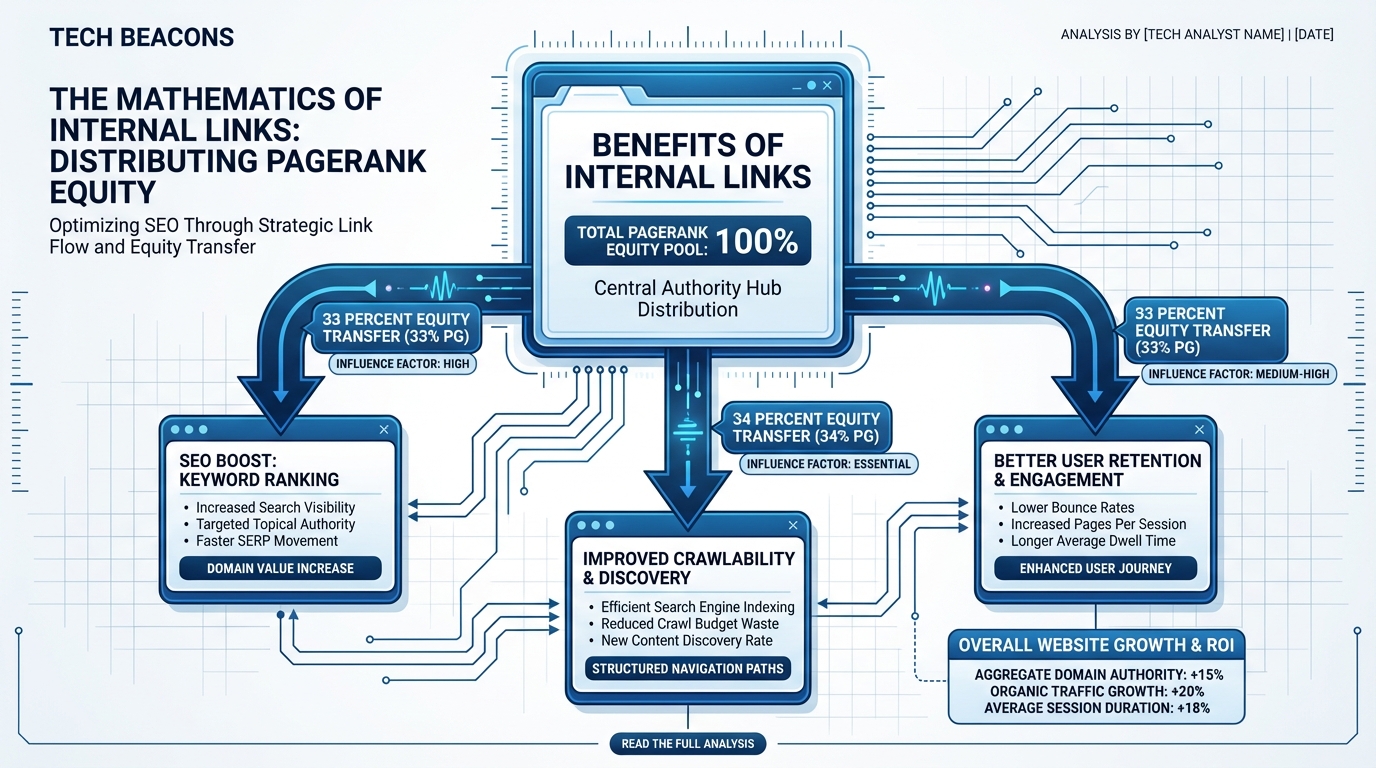
What are the benefits of internal linking?
Internal linking produces three measurable outcomes that drive revenue for scaling sites: crawl efficiency (fewer wasted bot cycles on low-priority content), link equity concentration (pushing authority to high-intent pages), and entity dominance for AI Overviews (establishing topic clusters that LLMs recognize as authoritative). These are not abstract SEO concepts; they directly affect indexation rate, ranking position, and traffic generation.
Crawl efficiency is the first-order benefit. Google allocates a finite crawl budget per domain based on site popularity and freshness signals. If your homepage links to 150+ pages, which is common in mega-menu designs, the crawler must prioritize which of those to visit first, often abandoning pages deeper in the crawl path. By reducing homepage outgoing links to a smaller set of high-priority targets, you push the crawler toward depth-crawling category pages and content hubs instead. The practical result is that new content gets discovered and indexed faster, which matters because a page's earliest crawls shape its initial ranking trajectory.
Link equity flow is the second benefit. A page's ranking power is finite. When you spread it across 150 outgoing links, each recipient gets a thin slice. When you concentrate it across 30 links, each recipient gets substantially more. This is why internal linking strategy, not raw volume, drives rankings. Category pages that receive several internal links from the homepage plus contextual links from related blog posts accumulate more equity than pages mentioned once in a footer widget.
Entity recognition for AI Overviews is the emerging third benefit. Large language models use internal link clustering to understand topic relationships and identify which pages represent authoritative nodes within your site's information architecture. Internal links act as citations within your own site; they tell the AI which pages are most connected to specific subtopics. When AI-powered search surfaces cite your content, they preferentially draw from pages with the highest internal link clustering, not just from pages with strong external backlinks. This is why topic clusters outperform scattered content for AI visibility: LLMs use cluster cohesion to rank authority nodes during retrieval.
How internal links affect SEO mathematically
The math of link equity distribution is straightforward but often oversimplified. Google's original PageRank formula, patented in the late 1990s, treats links as votes. A page casts votes through its outgoing links, and the value of each vote depends on the voting page's own cumulative authority. Critically, PageRank is not a simple equal division: a damping factor of roughly 0.85 is applied iteratively, meaning the actual equity each link receives is shaped by the global link graph, not just local outgoing link count. That said, the directional logic holds: adding more outgoing links from a page reduces the proportional authority each link receives, and removing low-value template links concentrates more equity into the links that remain.
Link equity dilution at the template level is where most sites leak ranking power. A typical WordPress site might have a header menu (12 links), footer menu (25 links), sidebar widgets (8 links), and a related-posts widget (5 links). That is 50 template links consumed before the page renders a single piece of content. On a homepage, every one of those template links competes with strategic content links for equity allocation.
Consider a homepage linking to 120 pages: 40 high-priority content targets plus 80 template and footer links. Each of those 120 links receives a proportionally smaller share of available equity. Trim that to 40 links by removing the low-priority template links, and each remaining link receives roughly three times the equity share. For category pages and pillar content, that kind of equity increase from the homepage can shift ranking positions on moderately competitive keywords, though the exact magnitude depends on the competitive landscape and the page's overall authority profile.
The question of how many links per page is "too many" does not have a single verified number. What is clear from research from seoclarity.net is that pages with a large proportion of low-relevance links (footer navigation, unrelated sidebar links, widget spam) signal a poorly maintained link architecture. The algorithmic response is not necessarily a direct penalty, but the engine weights other signals more heavily and trusts new content from that domain more slowly. The practical guidance: keep template links lean and ensure the majority of outgoing links from any given page are contextually relevant to that page's topic.
The impact of internal linking on AI Overviews and entity search
AI Overviews and Search Generative Experience rely on internal link clusters to answer two questions about your site: which pages represent authoritative nodes on this topic, and how are subtopics related. This is fundamentally different from how traditional Google Search uses links.
Traditional Google Search uses links (internal and external) as one ranking signal among many. The algorithm weights backlinks heavily for authority, then applies on-page factors (content, title, headers) and technical signals (speed, mobile-friendliness). Internal links contribute to crawlability and PageRank distribution but are secondary to external authority signals.
AI Overviews use internal links as a primary input to retrieval-augmented generation (RAG) systems. When an AI-powered search engine retrieves documents to synthesize an answer, internal links function as document relationship maps. If your site has an article on "dog training basics" linked to five subtopic articles (clicker training, positive reinforcement, correction timing, consistency in commands, tracking progress), the AI recognizes those five articles as related components of the same knowledge domain.
Semantic clustering beats keyword matching for AI discovery. A competitor site might have an article titled "How to train your dog" with keyword-anchored links like "dog training tips" and "puppy obedience training". But if those links do not connect topically related content, the AI does not recognize them as a cohesive knowledge cluster. Your site's semantic clustering, linking "dog training basics" to "clicker training" using natural anchor text like "clicker training works because", teaches the AI that your site treats these topics as connected.
The practical outcome: when an LLM synthesizes an answer about positive reinforcement techniques, it preferentially cites pages from sites where internal links showed those pages relate to broader training methodology. Pages from sites with scattered, non-clustered content are deprioritized even if they rank well in traditional search.
Building entity authority for AI search requires bidirectional linking within topic clusters. If article A links to articles B, C, and D, but B, C, and D do not link back to A or to each other, the AI sees isolated one-way citations rather than a knowledge cluster. When B, C, and D also link back to A and to each other, the AI recognizes a true topic authority cluster and treats the group as a coherent knowledge base superior to competitor pages on the same topics.
Can you have too many internal links?
Yes, and the problem is more specific than "reduce bloat."
Adding more outgoing links from a page mathematically reduces the equity each link receives. The relationship is proportional: more links mean thinner equity distribution per link. But the practical problems from excessive linking involve three distinct mechanisms: crawl budget waste, weakened trust signals, and user signal degradation.
Crawl budget waste occurs when a page carries so many outgoing links that Googlebot must queue lower-priority links for later crawling rather than following them immediately. Google has documented that crawl budget is a real constraint, particularly for large sites. Pages with a manageable number of outgoing links get fully traversed in a single crawl session. Pages loaded with link-heavy sidebar widgets, mega-menus, and footer navigation push discovery of deeper content backwards by days, which delays indexation and ranking for new pages.
Weakened trust signals come from link architecture patterns rather than raw count. A page with many low-relevance links (footer navigation, unrelated category links, widget sidebars unrelated to the page's topic) signals poor editorial curation. According to linkboss.io, excessive internal linking is often a characteristic of manipulative site structures. This does not mean automatic ranking drops, but it means the algorithm weighs other signals more heavily and is slower to trust new content or links from that page.
User signal degradation compounds the effect. Pages with very high link counts present decision friction. Users take longer to choose a path, bounce rates increase, and time-on-page decreases. These engagement signals feed back into ranking algorithms, particularly for pages targeting non-commercial keywords where engagement matters as much as authority.
The directional guidance: keep template links lean (audit header, footer, and sidebar menus regularly), and make the majority of links on any given page contextually relevant to that page's content. When both conditions are met, the links you do have carry more weight with both search engines and users.
What is the ROI of automated internal link deployment?
For a large site, the operational case for automating internal linking is straightforward: the manual alternative does not scale.
On a 1,000-page site, adding and maintaining internal links manually requires an editor to review each page, identify link opportunities, write contextual anchor text, and update the post. That process takes time that compounds as the site grows. A site publishing 20 new articles per month needs to not only link from new pages to existing content but also find opportunities in existing content to link to new pages. Doing that manually across a 1,000-page archive is a material ongoing labor cost. On a 10,000-page site, the task becomes effectively unmanageable without tooling.
Automated internal linking systems reduce that burden substantially. The question that matters operationally is not whether automation saves time (it does) but whether it maintains link quality compared to manual placement.
Keyword-matching automation, the kind found in basic WordPress plugins, tends to place links based on lexical overlap rather than topical relevance. A page on "dog training basics" might link to "dog collar reviews" because both pages contain the word "dog", even though the link adds no topical value. This reduces content quality signals and can register as a thin or manipulative link pattern if widespread.
Semantic automation, which uses language models to understand the context of surrounding text before suggesting a link, produces placements that are genuinely relevant to the content. The difference in link quality between the two approaches is significant enough that human review of semantically suggested links can shift from wholesale approval to exception-based spot-checking, which is where the real time savings emerge.
The adoption threshold for automation makes practical sense around 1,000 pages. Below that, manual editorial control is faster and easier to maintain. At 1,000 to 5,000 pages, automation handles the volume that manual review cannot without dedicated headcount. Above 5,000 pages, automation is the only viable path to complete internal link coverage.
Ranking lift from better internal linking is gradual. Sites typically see measurable position improvements in the weeks following a systematic internal linking deployment, with the gains concentrated on pages that were previously receiving few or no contextual links. The compound effect over six to twelve months, as newly linked pages accumulate authority and rank for additional queries, is where the financial return becomes clear. For a site monetizing organic traffic, each page that moves from page two to page one of search results represents a meaningful, recurring revenue increase without additional content cost.
Frequently asked questions
How many internal links should a page have?
There is no single verified optimum. What the underlying mechanics suggest is that pages benefit from keeping template links lean (header, footer, sidebar navigation) and ensuring contextual body links are topically relevant to the page. When template link count is high, it dilutes equity flowing to strategic links. Focus on quality and relevance over a specific number.
Do internal links from the homepage matter more than internal links from category pages?
Yes. The homepage typically carries the highest internal authority on a site. A link from the homepage passes more equity to a target page than a link from a lower-authority category page. This is why homepage link allocation matters: the pages the homepage links to receive a disproportionate share of the site's total link equity, which is why keeping that list focused on high-priority pages rather than every section of the site makes a measurable difference.
Should I use exact match keywords in internal link anchor text?
Use natural anchor text that describes what the linked page covers, rather than keyword-stuffed phrases. For AI Overviews, semantic relevance (does the anchor text relate to the target page's topic?) matters more than keyword matching. Anchor text that reads naturally within a sentence signals editorial intent; anchor text that reads like a keyword list signals manipulation.
How often should I audit and update internal links?
For sites under 1,000 pages, quarterly audits are sufficient. For sites between 1,000 and 5,000 pages, monthly audits to identify orphaned pages and fix broken internal links make sense. For sites exceeding 5,000 pages, automate the audit process using tools that scan for orphaned pages (zero internal links received) and redirect chains (links pointing to pages that 301-redirect elsewhere).
Does internal linking help with Core Web Vitals?
Internal linking does not directly affect page load time. It does affect crawl priority and indexation speed. A cleaner internal link structure, with fewer total links and more contextual placement, reduces HTML payload slightly and can reduce load time if heavy sidebar widgets containing many links are deprioritized in DOM order.
Can broken internal links hurt rankings?
Broken internal links (404s) do not directly hurt rankings but waste crawl budget. The crawler follows the link, receives a 404 response, and marks the page as dead. On subsequent crawls, the crawler deprioritizes crawling other links from pages with broken internal links, treating the site as poorly maintained. Fix broken internal links promptly, either by restoring the target page or updating the link to point to a valid current page.
Actionable takeaways
-
Reduce homepage outgoing links to a focused set of high-priority pages. Remove unnecessary template links, particularly footer menus with many items and sidebar widgets. Each removed low-value link increases the proportional equity flowing to the links that remain, directly improving authority for category and pillar pages.
-
Map internal link equity to revenue-impact pages first. Identify the pages that drive most of your revenue or business value: product pages, service landing pages, high-intent blog content. Ensure each receives multiple internal links from higher-authority pages and contextual links from related content. The flow should follow a logical hierarchy from homepage to category to pillar to supporting content.
-
Implement bidirectional linking within topic clusters. Pages covering related subtopics should link to each other and back to the main pillar page. This teaches LLMs that your site has cohesive topical knowledge, increasing citation likelihood in AI Overviews.
-
Audit for orphaned pages monthly. Use Google Search Console's "Crawled, not currently indexed" report or an automated crawler to identify pages with zero internal links. These pages accumulate no equity and rank for nothing despite being live. Add links to them from contextually related content as soon as they are identified.
-
Replace keyword-matching anchor text with semantic descriptors. Instead of "dog training tips", use "clicker training works because". This signals semantic relevance to both search engines and LLMs rather than relying on keyword density.
-
Automate internal link deployment if your site exceeds 1,000 pages. Manual internal linking becomes an ongoing labor cost at scale. Semantic AI-based automation, which evaluates context rather than just word overlap, maintains placement quality while reducing the time required from hundreds of hours annually to a manageable review workflow.
-
Test before deploying links at scale. If using automation, pilot-deploy links to a subset of your site. Monitor rankings, traffic, and engagement metrics for several weeks before rolling out to the full archive.
Related Reading
- Internal Linking for eCommerce Sites: Complete Guide: Learn how to structure internal links for product pages and category hierarchies to maximize equity flow.
- Internal Linking Best Practices: A tactical guide to anchor text selection, link placement, and avoiding common pitfalls in internal linking strategy.
- Does Internal Linking Help SEO?: Explore case studies and data on how strategic internal linking impacts rankings and crawl efficiency.