Do outbound links help SEO? The mathematical and semantic impact in 2026
An outbound link is a hyperlink that points from your website to a page on a different domain. Unlike the persistent myth that linking out drains your ranking authority, outbound links signal content credibility to search engines and AI-driven systems. In 2026, the question is not whether to link out, but how to balance outbound links mathematically against internal links and ensure those links point to semantically relevant entities that reinforce your niche authority.
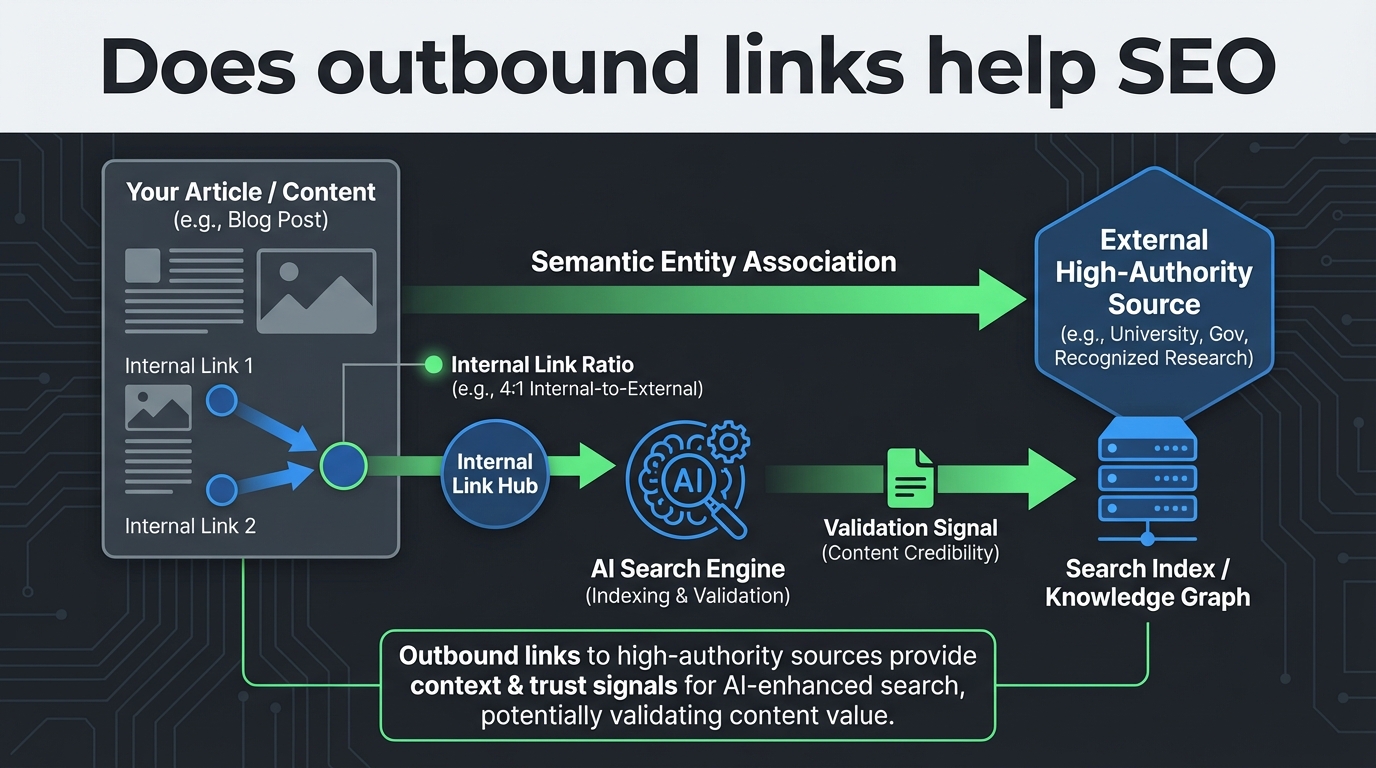
What are outbound links and do they improve SEO?
Outbound links are not a direct ranking factor. Google's John Mueller stated in August 2023 that linking out to popular websites does nothing to improve your page's rankings directly. That statement has created widespread confusion about whether outbound links matter for SEO at all. They do, but indirectly.
Outbound links help search engines understand the topical neighborhood of your content through entity association. When you link to a research institution focused on climate science, you signal that your page belongs in the climate-science conversation. They also improve user experience by providing citations that readers can verify. And they contribute to E-E-A-T credibility by demonstrating you cite authoritative sources rather than making isolated claims.
The confusion stems from misunderstanding how PageRank flows. The fear that linking out "leaks" your authority is technically incorrect. When you place an outbound link, you do not lose authority; you distribute PageRank across all links on that page. How that authority flows depends on the number of links and their attributes, but the origin page does not become weaker simply because it linked out.
How outbound links affect AI Search Overviews and entity association
Entity association is how search engines and large language models use outbound links to categorize your content into a topical space. AI systems no longer process links as simple vote counts. They interpret links as semantic signals and co-citation patterns. When multiple authoritative sources on climate science cite the same research institutions, those institutions become recognized as core entities in the climate domain. Your outbound links to those institutions tell the AI which neighborhood your content occupies.
This mechanism resembles the historical Hilltop Algorithm concept, which ranked pages higher if they received links from pages that linked to multiple high-quality sites in the same topic. In the context of AI Overviews, outbound links function as evidence that your content participates in the broader conversation around your topic. A page about machine learning that cites no external research appears insular to AI systems trained on patterns where real domain experts routinely link to authoritative sources.
Large language models are trained on web data where credible sources link to other credible sources. When you replicate that linking pattern, you signal to AI systems that your content belongs to the credible ecosystem. This is part of why AI Overviews have expanded beyond informational queries to commercial and comparison queries in 2026: AI systems now treat outbound link context as one verification layer when assessing source credibility, according to research from Respona.
Semantic relevance matters more than raw domain metrics here. A link to a sustainability research center from an article about sustainable fashion carries more evidentiary weight than a link to a high-traffic fashion blog with no sustainability focus. The relationship between your anchor text, the linked content, and your page's theme is what search systems actually read.
What is the 80/20 rule for SEO link ratios?
The internal-to-external link ratio is a mathematical constraint driven by crawl budget and topical coherence. Best practice points to maintaining a 3:1 or 4:1 ratio of internal links to external links on a single page. This ratio does not improve rankings directly, but it prevents two problems: excessive crawl budget consumption on exits from your domain, and dilution of topical authority within your own site structure.
Here is the mechanics. Every link on your page consumes a portion of Googlebot's crawl budget. Each outbound link is a potential exit point that sends crawlers outside your domain. A page with many outbound links but few internal links signals to Google that your content functions more as a traffic distributor than as a hub for your own content. You also fail to reinforce your own topical clustering when internal links are absent.
Consider a practical example: an article with 4 internal links to related pages and 1 outbound link to a cited source stays within the 4:1 target while keeping crawlers focused on your own domain. The exact ratio depends on your site structure, but the principle is consistent. Internal links should outnumber outbound links to protect crawl budget and maintain topical structure.
Automating the internal side of this balance helps. Tools that use semantic analysis to identify contextually relevant internal link opportunities, rather than simple keyword matching, make it easier to maintain that 3:1 or 4:1 ratio without auditing every page manually.
What type of link is best for SEO attribution?
Link attributes determine how a link transfers authority and how search engines treat it. Three primary attributes govern outbound links: dofollow, nofollow, and sponsored.
A dofollow link (the default) passes PageRank to the linked page and signals endorsement. Use dofollow for links to high-quality sources you genuinely trust and want to signal endorsement for. If you write about SEO and link to Google Search Central documentation, dofollow is appropriate because you are signaling endorsement to search engines.
A nofollow link tells search engines to ignore the link for PageRank purposes. Use nofollow for links to sites you cannot fully vet, user-generated content links, and competitor references you must acknowledge without promoting. Nofollow links still provide semantic signals; AI systems still read the anchor text and context, but no ranking credit transfers.
A sponsored link is required for any link where money or goods changed hands. Affiliate links, paid partnerships, and advertisements need rel="sponsored". Google requires this attribute and enforces it because unattributed paid links distort the link graph.
In practice, most outbound citations should be dofollow if you trust the source. Reserve nofollow for situations where the link is necessary but the source is unvetted or contested. Applying nofollow broadly to all external citations can undermine the credibility signals you are trying to build, because it suggests you are not confident in the sources you chose to cite, as noted by Neil Patel.
How to audit your site for outbound link rot
Link rot occurs when outbound links point to pages that no longer exist (404 errors), have moved to new URLs with broken redirect chains, or have been removed entirely. Broken outgoing links create two problems. First, they degrade user experience when visitors hit dead ends. Second, they signal to search engines that your content is not actively maintained despite appearing current.
To audit outbound link rot, use a crawl tool such as Screaming Frog, Semrush, or Ahrefs. Set the tool to crawl your domain and report external URLs. Filter for status codes 404 and 410, and flag redirect chains longer than two hops. For each broken link, decide whether to update it to the new URL if the resource moved, replace it with an equally authoritative source, or remove it if the citation is no longer relevant.
A second layer is manual sampling. Pick a set of outbound links from your highest-traffic pages and verify they still point to correct, live content. If a resource moved but the old URL returns a clean 301 redirect, that is acceptable. If the redirect is broken or chains beyond two hops, crawlability suffers.
For ongoing maintenance, build link audits into your regular content review cycle. Sites with large content libraries accumulate broken outbound links faster because referenced external sources move or go offline over time. Catching those breaks before they compound keeps your topical connections to external entities intact, as explained by Ankit Chauhan.
Related Reading
- What Is Internal Linking? A Complete Beginner's Guide – Learn the fundamentals of internal linking and how it differs from outbound links.
- Internal Linking Strategy 2026: SEO Hyperlinks – Explore how hyperlinks function in modern SEO and their role in entity association.
- Best Free Internal Linking Plugins for WordPress – Discover tools to automate internal linking and maintain optimal link ratios.
Frequently Asked Questions
Does linking to competitors hurt SEO?
Linking to direct competitors does not hurt your SEO rankings, but it does send traffic elsewhere. Use this selectively: link to competitors when acknowledging alternative approaches or when their content is genuinely the best resource on a subtopic. For most cases, unlinked mentions work better. You can reference a competitor's name without a link, which acknowledges the competitive landscape without passing traffic or PageRank.
Should all outbound links open in a new tab?
Opening outbound links in a new tab (target="_blank") is a user experience choice, not an SEO factor. A common approach is to open external links in a new tab to keep users on your site, and open internal links in the same tab to encourage site exploration. Neither choice has a direct impact on rankings.
How many outbound links per page is optimal?
There is no fixed number, but 1 to 3 outbound links per page is practical for most content. Pages with no outbound links lack citations and secondary validation. Pages with more than 5 links risk fragmenting crawl budget and reducing the value of each individual link. For long-form content above 3,000 words, 4 to 6 outbound links are reasonable if they are distributed evenly and semantically relevant to the section where they appear.
Do outbound links impact crawl budget?
Yes, indirectly. Each outbound link is a potential exit point for Googlebot. Pages with many outbound links reduce the crawl budget percentage spent on your own internal pages. This is why the 3:1 or 4:1 internal-to-external ratio matters for sites with large content libraries. On smaller sites with fewer than 100 indexed pages, crawl budget is rarely a limiting factor, so the ratio matters less in practice.